


Metal Mastery: Hindu Zinc Science Not Myth
- Hinduinfopedia
- May 3, 2025
- 3 min read

Updated: May 10, 2025
The Science of Hindu Metallurgy
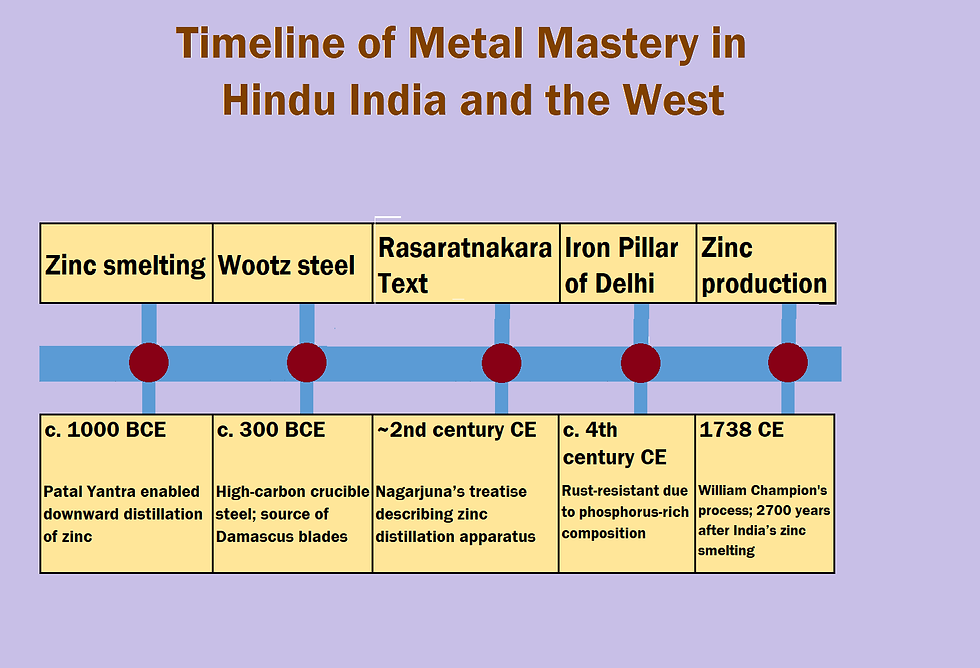
Hindu metallurgy defies the Western “mythology” tag, revealing a science shaped by precision and fire. Ancient texts like the Rasaratnakara, from around the 2nd century CE or earlier, describe zinc extraction with a level of detail Europe didn’t achieve for centuries. This isn’t folklore—it’s rigorous science. Like the Nasadiya Sukta’s cosmic inquiries or Sushruta’s surgical precision , Hindu metallurgists relied on empirical methods, not superstition. This post examines how India’s mastery of zinc, steel, and rust-free iron redefines ancient scientific achievement.

Method Over Myth: A Legacy of Precision
Colonial biases often labeled Hindu achievements as myths, but ancient texts reveal a tradition of observation and experimentation. From astronomy to medicine, Hindu knowledge was scientific. Metallurgy, especially zinc smelting, emerged by 1000 BCE, outpacing global peers. These techniques also influenced Rasa Shastra, extracting medicinal compounds using sealed retorts and furnaces. This cross-disciplinary approach underscores a legacy of applied science, not myth. Let’s explore the technology behind this process.
Patal Yantra: Engineering Excellence
The patal yantra, a cornerstone of Hindu metallurgy, was a marvel of engineering. Meaning “underground apparatus,” this sealed, inverted furnace used downward distillation, a method far ahead of its time. By 1000 BCE, it extracted zinc and later mercury for Ayurvedic elixirs . Zinc ore and charcoal were sealed in a clay retort, heated to over 1000°C, and the vapor condensed in a cooled lower vessel. Excavations at Zawar, Rajasthan, have uncovered these retorts, confirming their historical use.

Pull Quote: “Patal yantra isn’t myth—it’s metallurgy, distilled in clay and fire.”
Zinc Distillation: A Scientific Feat
The patal yantra enabled zinc production on an industrial scale. By 1000 BCE, Zawar’s smelting sites operated with multiple furnaces, producing zinc consistently. Archaeological evidence shows coordinated pits, ash layers, and standardized vessels, indicating organized production and labor specialization. This system, with precise materials and cooling methods, predated modern chemical engineering by centuries.
Visual Suggestion: Add an image of Zawar’s excavation site showing multiple retorts.
Caption: “Zawar smelting complex: industrial-scale zinc production 2,700 years ahead of Europe.”
Pull Focus: India didn’t just discover zinc—it mastered its controlled, replicable extraction at scale.
Wootz Steel: Molecular Mastery
By 300 BCE, Hindu metallurgists developed wootz steel, a high-carbon alloy forged in crucibles. This steel, known as Damascus steel, reached Arabia, Persia, and Rome, its carbon nanotube structure making it stronger than Roman blades. It was a product of centuries of experimentation and documentation.
Iron Pillar: A Metallurgical Marvel
In the 4th century CE, the Iron Pillar of Delhi showcased Hindu metallurgy’s precision. Rust-free for over 1,600 years, its high phosphorus content and slag cooling defied corrosion, a feat modern science only recently replicated. This 6-ton structure reflects the same empirical approach that mastered zinc centuries earlier.

What do you think preserved the Iron Pillar for so long? Comment below.
Colonial Missteps: Ignoring Science
Colonial rule dismissed Hindu metallurgy as superstition, replacing traditional education with English systems in 1835. Ancient texts were sidelined, but smelting sites, rust-free artifacts, and steel trade prove their reality. Hindu metallurgists preserved their knowledge through oral traditions, resisting colonial erasure.
2025 Insights: Metallurgy’s Future
Today, Hindu metallurgy informs modern science. IIT Kanpur’s research on wootz steel’s nanostructure inspires aerospace and biomedical alloys. Ancient smelting techniques guide sustainable mining. As India reclaims its heritage through initiatives like AYUSH, these achievements shape a future rooted in dharmic balance.
Wrapping Up
Hindu metallurgy—from zinc distillation in 1000 BCE to nanostructured steel and rust-free iron—demonstrates science, not myth. These were calculated achievements, not fables. As we explore Vedic wisdom—from cosmic hymns to surgery —Hindu knowledge stands as Real, Not Myth. Next, we’ll uncover Vedic hydrology’s ecological science.
Pull Quote: “Hindu metallurgy forged facts in fire, not fables in pews.”
Call to Action
How does rediscovering Hindu metallurgy reshape your view of ancient science? Comment below and subscribe to HinduInfoPedia for our next post: Water’s Cleansing Wisdom in Vedic Science.
Internal Link: Revisit Sushruta’s surgical legacy to trace empirical traditions.
Originally Published at
Watch Related Videos here





Comments